



Short answer: Yes, foreclosures are up from last year, but they are starting from a very low base. They remain below 2020 levels and far below the 2008 crash. With inventory in a balanced range nationally, even tighter here in Morris County, and most owners holding solid equity, we don’t expect a wave of distressed homes.
Almost twenty years after the 2008 crash, “foreclosure” is still a word that makes people sit up. If you’ve seen a recent headline and you’re thinking about buying or selling in Morris County, it’s reasonable to ask whether a flood of foreclosed homes is about to hit the market.
Some buyers are hoping for a run of bargains. Some sellers are worried about extra competition. The current numbers don’t support either outcome, and knowing why can help you plan your move with a clear head.
Foreclosures Are Rising, but From a Very Low Starting Point
ATTOM reports that completed foreclosures are running 33% higher than a year ago. On its own, that sounds like a lot. It looks very different once you set it next to recent history.
Even after that jump, completed foreclosures are still roughly 26% lower than they were in the first half of 2020.
Look further back and the gap gets much wider. According to ATTOM, lenders finished about 28,000 foreclosures in the first half of 2026. In the crash years, shown in red below, lenders routinely completed more than 200,000 in just a few months (see graph below):
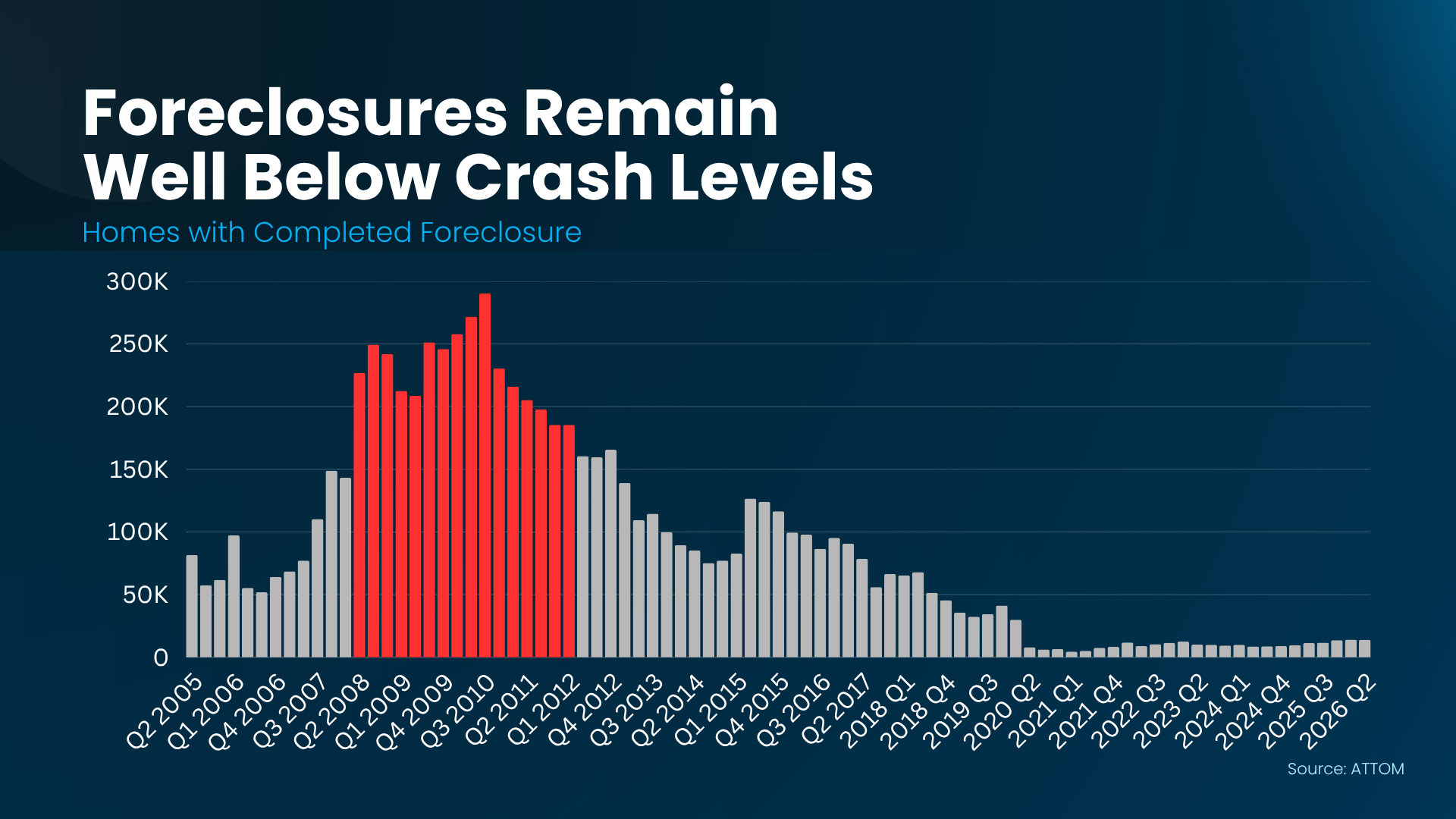
Industry analysts read these numbers as a sign of a market in good health. Rob Barber, CEO of ATTOM, has pointed out that while some homeowners are under financial strain, total foreclosure activity is still well under historical norms and the wider housing market keeps holding up.
There’s also a simple reason the market can absorb a modest increase like this one.
Housing Inventory Is Balanced Nationally, and Tighter in Morris County
During the crash, huge numbers of owners either lost their homes or had to sell under pressure, and the market was buried in listings. We are not seeing anything like that today.
A helpful gauge is months’ supply: how long it would take to sell every home currently listed at today’s pace of sales. Four to six months is generally considered a balanced market.
The National Association of Realtors (NAR) puts the national figure at about 4.8 months right now. That’s squarely in the balanced range and less than half of where it peaked around the last crash (see graph below):
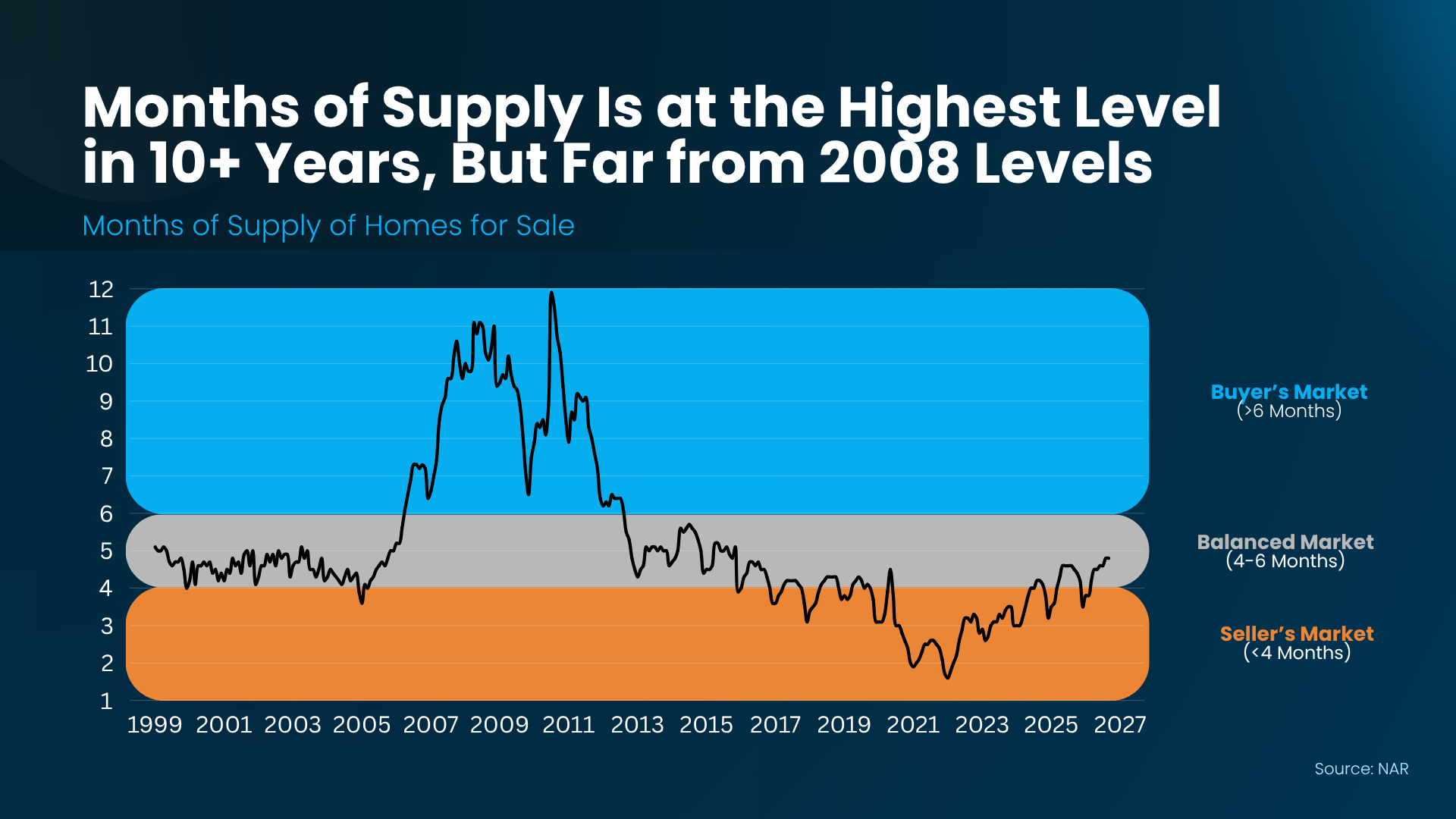
If foreclosures were really surging, it would show up in the number of homes for sale. Logan Mohtashami, lead analyst at HousingWire, has made the same point: a true wave of foreclosures this year would have pushed inventory far higher than what the data shows.
What This Means in Morris County
Locally, supply is even leaner than the national number. Here’s how single-family homes in Morris County looked in October 2026, according to the New Jersey REALTORS® monthly market report:
| Morris County single-family, Oct. 2026 | Figure | Change vs. Oct. 2025 |
|---|---|---|
| Months’ supply of inventory | 2.3 months | Up from 1.9 months |
| Homes for sale | 704 | Up 18.7% |
| Median sales price | $773,000 | Up 3.8% |
| Percent of list price received | 102.9% | Down from 103.6% |
More homes are on the market than a year ago, which gives buyers a bit more to choose from. Still, at 2.3 months of supply, Morris County remains well short of the four-to-six-month balanced range, and homes are still selling above asking on average. For a fuller look at local trends, see our Morris County real estate market update for November 2026.
Home Equity Gives Today’s Homeowners Options
Equity is a big reason we aren’t seeing a wave of distressed sales. Data from the Census Bureau and ATTOM shows that close to two out of three homeowners either own their home outright or have more than 50% equity. Cotality estimates the average homeowner has roughly $310,000 in equity.
When an owner with that kind of cushion runs into a hard stretch, they can usually sell, pay off the loan, and keep the difference rather than face foreclosure. Many owners didn’t have that option during the crash. HousingWire notes that nearly one in four homes were underwater in 2010.
Being underwater means owing more on the mortgage than the home is worth, which makes selling much harder. Today, only about 2% of homeowners are considered seriously underwater (see graph below):
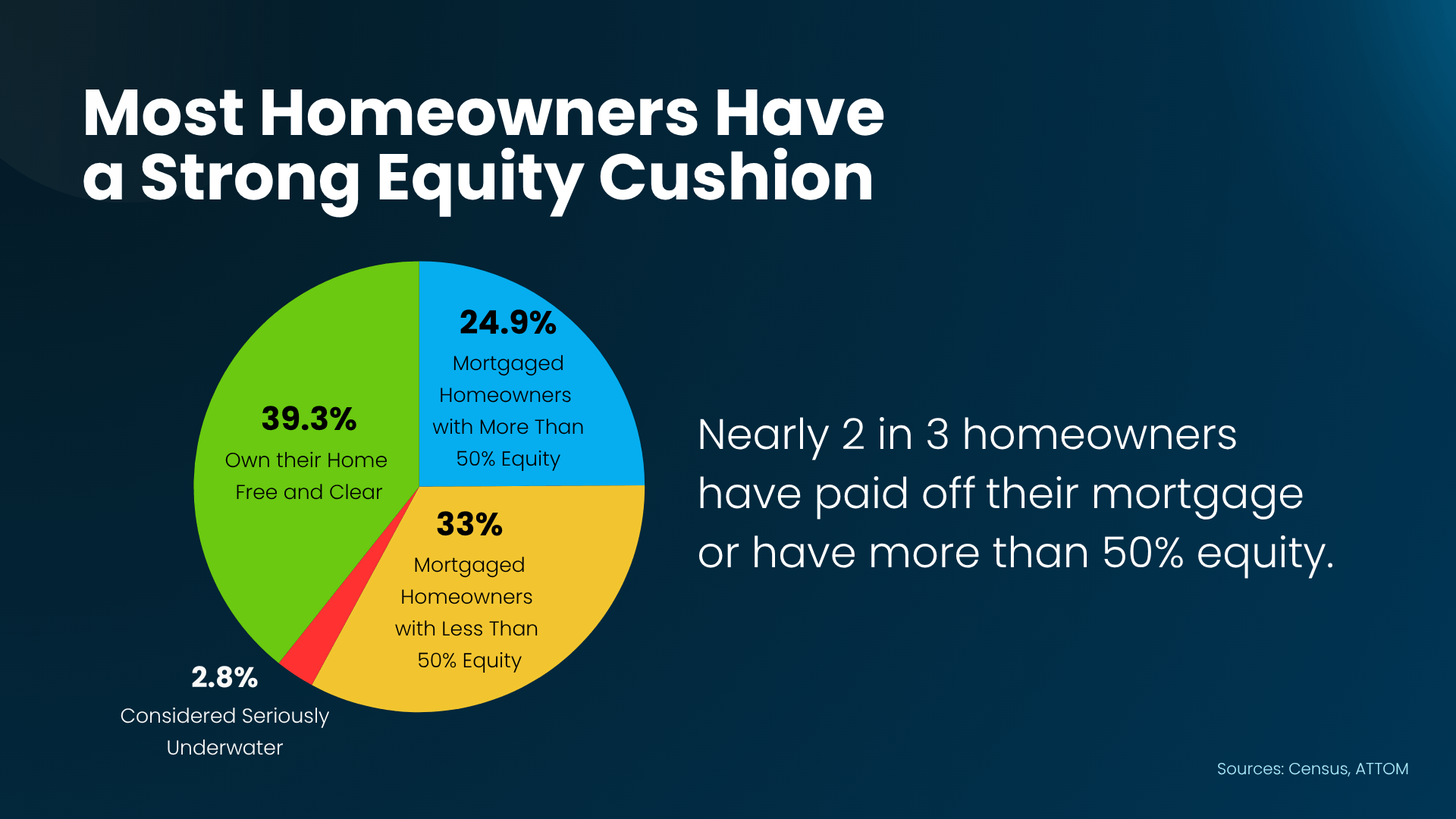
Not every owner has that much equity, but most do, and that’s what limits how high foreclosures can climb. If you’re a seller sorting through your options, our guide on what to do if your house won’t sell covers practical next steps. Buyers may find our post on rates versus buyer leverage in Morris County useful too.
Foreclosures and the Housing Market: FAQ
Are rising foreclosures a sign the housing market is about to crash?
No. Completed foreclosures are up from last year, but they are still about 26% below the first half of 2020 and a small fraction of crash-era levels. Balanced inventory and strong homeowner equity are the main reasons analysts don’t expect a repeat of 2008.
Will more foreclosures bring home prices down in Morris County?
The current data doesn’t point that way. In October 2026, single-family homes in Morris County had just 2.3 months of supply and sold for a median of $773,000, up 3.8% from a year earlier. A small rise in national foreclosures is not enough to change that picture on its own.
Is it a good time to look for a foreclosure deal in Morris County?
We wouldn’t plan a home search around foreclosures right now. Volumes remain low and local supply is tight, so distressed properties are a small slice of what’s for sale. A better approach is to get pre-approved, watch the full market, and be ready to move when the right home comes up.
Bottom Line
If the recent foreclosure headlines have you wondering where the housing market is going, the data says it’s on steady footing. Inventory is in a balanced range nationally and still tight in Morris County, and most homeowners have plenty of equity to work with. If you have questions about what you’re reading, how our local market is moving, or how much equity you have in your own home, our team is happy to walk through it with you.
This article is general information only and is not legal, tax, investment or financial advice. Market data and forecasts can change.
Sources
- ATTOM – foreclosure activity reports
- National Association of Realtors (NAR) – existing-home sales and months’ supply
- HousingWire – inventory analysis and historical underwater data
- U.S. Census Bureau and ATTOM – homeowner equity data
- Cotality – homeowner equity report
- New Jersey REALTORS® Local Market Update, Morris County, October 2026
Adapted from Keeping Current Matters research.
Talk to the MorrisAgent Team
Want to see what this means for you? We’ll sit down and run the real numbers. Call (973) 200-4800, email [email protected], or stop by our office at 518 Main Street, Suite 102, Boonton. No pressure, and no surprises.